Ninja
- Type of sport
- Standalone obstacle sport
- Course
- Fixed sequence of obstacles, little running
- Obstacles
- Depends on the course
- Scoring
- Highest checkpoint reached and time to get there
- Olympic
- No
- Federations
- IG Ninja-Sport · internationally UIPM
Athletics
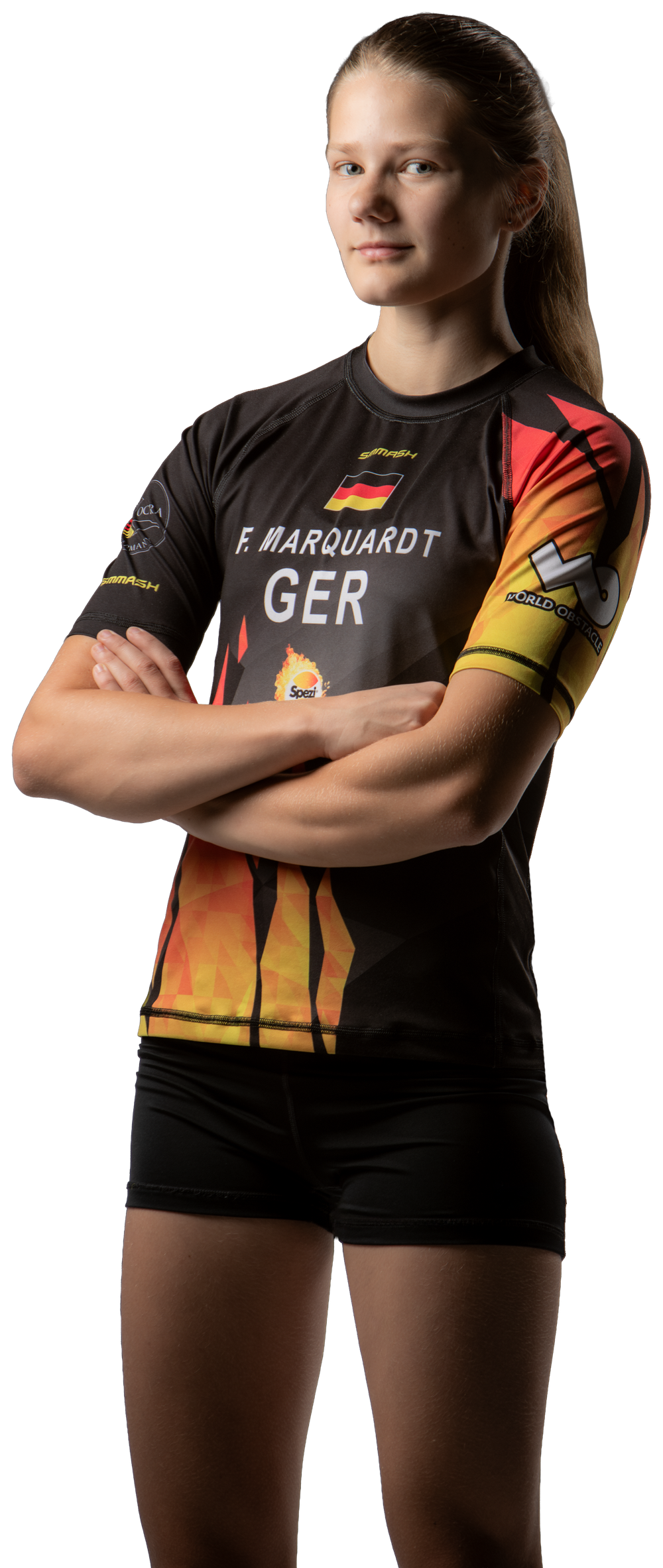
Ninja sport is an obstacle sport in which athletes tackle a fixed sequence of obstacles with little running. A run usually lasts one to five minutes.
The model is the Japanese TV show “Sasuke”, broadcast by TBS since 27 September 1997. The format has been adapted in 26 countries. The German edition, “Ninja Warrior Germany”, has aired on RTL since 9 July 2016.
The governing rulebook is the IG Ninja-Sport ninja rulebook, version 2026. Among other things, it defines:
The Ninja Competition Rules 2023 describe “Ninja Speed” as a timed race over 10, 11 or 12 obstacles, head-to-head or as a time trial. A failed obstacle may be repeated once, except after landing in the water.
The IG Ninja-Sport (IGN) was founded on 28 January 2024. It writes the rulebook, trains judges and runs the ninja ranking that decides the German champions. 2025 season: 37 events with 1,051 athletes. The Ninja-Bundesliga is a competition series run by Ninja-Bundesliga UG; it is independent of the IGN but follows its rules. Internationally, ninja has been part of the UIPM since August 2026; the 2026 Ninja European Championships in Pilsen (Czech Republic) are the first under its umbrella. According to the UIPM, ninja remains a sport in its own right.
How it differs: Ninja is not an Olympic sport. According to the IGN, the new pentathlon discipline – now called “Obstacle Racing” by the UIPM – is “related to ninja, but far from the same thing”.
Speed course
OCR100 is the sprint discipline of obstacle racing: a timed race over 100 metres with 12 obstacles. Since 2026, the world federation UIPM has used “Obstacle Racing” instead of “Obstacle Course Racing” (OCR). It is a standalone competition format, not a discipline of modern pentathlon.
Exactly 100.00 metres from start to finish line, with less than 1% gradient. The twelve obstacles follow a fixed order:
Races are run head-to-head on 1 to 8 lanes at least 1.5 metres wide, or as a time trial. All obstacles must be completed. An athlete who fails an obstacle may repeat it once; if the second attempt also fails, the run is over (“Did Not Complete”, no time). There are no time penalties. Depending on the field, the heats are followed by quarter-finals, semi-finals and a final.
Internationally, the rules were the responsibility of FISO / World Obstacle; since 10 August 2026 the UIPM has been in charge. In Germany, OCRA Germany e.V. (Obstacle Course Racing Association Germany) selects Team Germany for the European and World Championships. The highlight each year is the UIPM Obstacle World Championships in Beijing (2026 with 100 m, 400 m, 4×100 m and 3 km). From 2027, the European Championships are called “Obstacle Racing European Championships”; they take place in Tartu (Estonia) from 1 to 4 July 2027.
One of Five
OCR70 – “Obstacle-Course-Race 70” at the DVMF, now “Obstacle Racing” at the UIPM (formerly “Obstacle”) – is the obstacle race of modern pentathlon: eight obstacles over about 70 metres, usually two athletes head-to-head, with a finish wall as the last obstacle.
It replaces show jumping in modern pentathlon: in youth competition since 2023, for adults after the Paris 2024 Games. It will be Olympic for the first time at the Los Angeles 2028 Games. Pentathlon consists of fencing, obstacle racing, swimming and laser run. The DVMF also holds OCR70 as a standalone competition; the first German Championships took place in Bonn on 14 November 2026.
The UIPM provides for two basic configurations:
| No. | U15 / U17 / U19 | Juniors / Seniors |
|---|---|---|
| 1 | Steps | Steps |
| 2 | Big Wheel | Big Wheel |
| 3 | Rings | Tilting Ladders |
| 4 | Over-Under-Through | Over-Under-Through |
| 5 | Wheels | Choice: wheels, flying hoops or ascension bars |
| 6 | Balance Beam | Giant Steps |
| 7 | Monkey Bars | Choice: rings, climbing holds or swinging globes |
| 8 | Finish Wall | Finish Wall |
The finish wall is 3.50 metres high and the ramp 3.50 metres long. The obstacles demand strength, balance, agility, coordination and grip strength.
An athlete who fails one of obstacles 1–7 runs back around the outside to the start of the obstacle and tries again. If the second attempt also fails, there is a 10-second time penalty and the athlete moves on to the next obstacle; at the finish wall it is 20 seconds. Anyone who clears fewer than five of the eight obstacles is disqualified. A false start costs 10 seconds. Each athlete has two scored runs, and the faster time counts. Age groups range from U15 to Masters 60+, plus two-person relays (women, men, mixed).
Internationally, the first fault at an obstacle results in a warning, the second at the same obstacle in elimination.
The obstacle time is converted into points using a table. In the closing laser run, athletes start according to the points they have collected so far: each point behind the leader means starting one second later, and the first across the line wins. For the obstacle laser run, the UIPM guidelines 2026 state that 0.33 seconds equal one point.
From A to Z